Banking, Canada, Economics, Finance, Inflation

Senate Banking Committee Appearance: Introductory Remarks

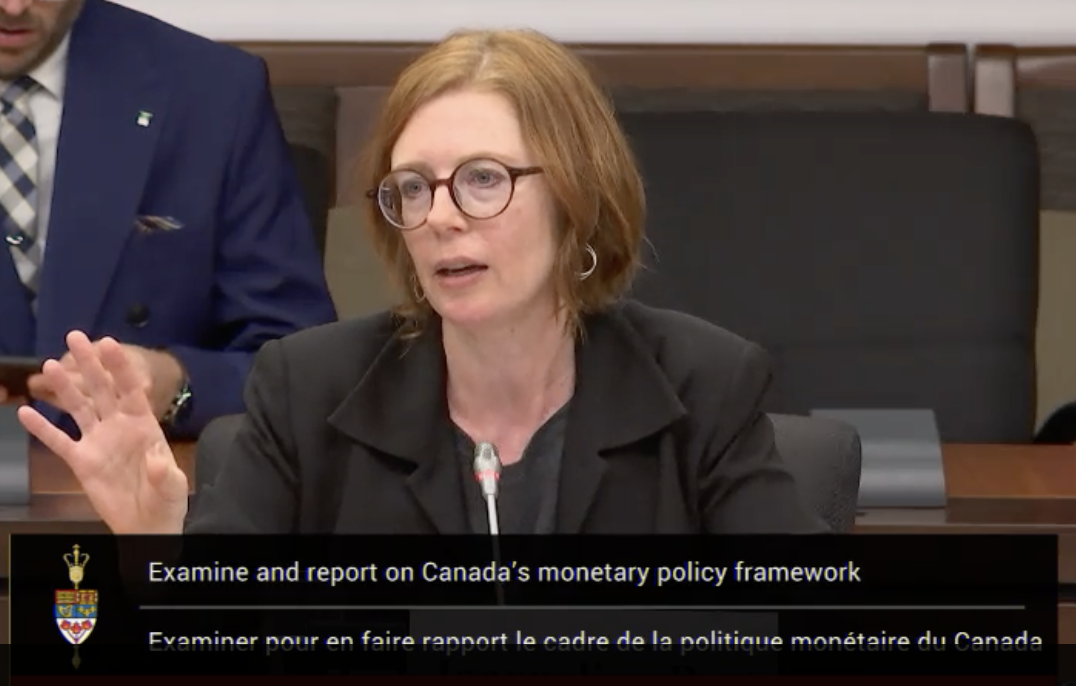
These were my opening remarks for my appearance before the Canadian Senate Committee on Banking, Commerce and the Economy on November 20, 2024:

J’aimerais commencer en vous remerciant de m’avoir offert la chance de témoigner dans le cadre de votre étude sur le cadre de politique monétaire du Canada.

Much of my research is on the history of monetary policy and financial governance in the US, UK and to a lesser extent, Canada. What that research has taught me is that we are no longer in the era of the Great Moderation: the label we give to the period of macro-economic stability that lasted from the 1990s through to the 2008 global financial crisis—an era defined by low inflation and relatively few economic crises. Unfortunately, our era has a lot more in common with the 1970s and 1980s, a time of instability and significant economic and political shocks.

It also seems very likely that we will continue to live in a highly uncertain global economic environment in the coming years, given the current trends in geopolitics and the impact of the climate crisis. This heightened uncertainty will require more creativity and discretion from economic policymakers, including central bankers. More discretion in turn requires more robust forms of political accountability.

The Bank of Canada has an excellent international reputation, which is well-deserved, and it punches above its weight in international policy circles. It has also deal effectively with some very significant shocks in the last few years.

However, there is still room to improve, as the Bank of Canada remains behind its peers in terms of international best practice.

In particular, there is room to improve on governance, on transparency and on its mandate.

I am happy to elaborate on these areas in our conversation today. For now, I will close by noting that reforms in these areas will provide the Bank of Canada with the accountability that it needs to sustain confidence and build trust as we negotiate the challenging times ahead.

Banking, Economics, Finance, Inflation

Super-heroes or super-villains? How significant are central banks to the inflationary cycle?

Photo by Erik Mclean on Pexels.com

As inflation finally drops below 2 per cent all eyes are on the Bank of Canada’s next interest rate decision on Wednesday, with markets predicting a half-percentage drop. Meanwhile, the U.S. Federal Reserve finally started bringing rates down in September after raising them 11 times since March of 2022.

Does this mean that central bankers are the superheroes who have saved the day yet again? Or are they the supervillains that their critics make them out to be, responsible for the inflation that has driven the recent cost of living crisis?

Both of these narratives make the same basic assumption: that central banks have huge influence, for good or ill, over the state of the economy.

But do they really? As we enter a new phase in the monetary policy cycle, it’s worth taking a closer look at what central banks’ role is – and what it could be.

It’s not at all clear that central banks were responsible for driving inflation up in the first place. And there is growing evidence that central banks have not affected inflation’s ups and downs anywhere near as much as they or their critics might like to claim.

A recent paper by French economist Olivier Blanchard and former Fed chair Ben Bernanke shows that most of the pressures driving post-pandemic inflation were linked to supply chain blockages, energy price shocks, and energy-related food price changes – none of which can be directly addressed through interest rates. While exceptionally low interest rates and quantitative easing – where the government buys up bonds on the open market to push rates down further – may have lasted longer than was prudent, they were not the main cause of post-pandemic inflation. The Bank of Canada is not the supervillain that its critics make it out to be.

More strikingly, it’s not clear that central banks’ policies played the primary role in taming pandemic-driven inflation. Most of the recent decrease in inflation can be attributed to the unwinding of temporary factors such as supply constraints and the shift in consumer demand from services to goods.

It’s true that inflationary expectations haven’t jumped the way that policymakers feared, but it’s not clear that this is because of the actions of central bankers (even if Fed Chairman Jerome Powell has been quick to take credit). Central banks are also not the superheroes of the economic story.

That doesn’t mean, of course, that the interest-rate hikes of the last two years didn’t have a major impact on our economy. Just ask anyone with a floating variable-rate mortgage, where payments have increased by an average of 49 per cent as of 2023, or those renewing in the next few years, who could alsoface a “payment shock,” as Canada’s banking regulatory, OSFI, noted in its last report.

If the Bank of Canada isn’t the superhero or supervillain, and yet its actions do significantly shape our lives, what should its role be?

The Bank of Canada can do more. Although central banks may not have saved the day this time, they do have tools they could use in this era of increasing uncertainty.

The Bank of Canada could take a more holistic approach to managing inflation by expanding its mandate to follow the U.S. Fed’s lead in formally taking employment into account, as Senator Diane Bellemare has proposed in Bill S-275. It could also take inspiration from the European Central Bank, which has developed innovative tools for making the financial system part of the solution in tackling climate change, instead of accelerating the crisis.

The Bank of Canada can also do less. Too often, politicians rely on central banks when the economy is in crisis, preferring to have unelected bankers make the tough decisions. We need to develop better co-ordination between fiscal and monetary policy and expand the economic toolkit so central banks aren’t our only go-to when we are confronted by a recession, a pandemic, a bout of unexpected inflation, or another financial crisis.

And the Bank of Canada can do better. Conservative Leader Pierre Poilievre’s threats to fire the Governor of the Bank of Canada were inflammatory and dangerous. The Bank of Canada is well respected at home and abroad. But that doesn’t mean that there’s no room for improvement. Central banks make decisions that affect millions of people: they need a governance structure that is open and accountable. The Bank of Canada is well behind its peer institutions in that regard, with interest rate decisions being made by internal consensus rather than through open deliberation.

We don’t need the Bank of Canada to be a superhero. We do need it to play a constructive, collaborative and innovative role in today’s economy.

This article first appeared in The Globe and Mail on October 22nd, 2024.

Banking, Canada, Finance, Inflation

Why we can’t just ‘stop printing money’ to get inflation down

https://images.theconversation.com/files/457998/original/file-20220413-26-h1sbqm.JPG?ixlib=rb-1.1.0&rect=0%2C343%2C6352%2C3176&q=45&auto=format&w=1356&h=668&fit=crop

With the Bank of Canada announcing an oversized interest rate hike this week, it might seem like central banks are coming to rescue us from inflation once again. Yet while they did play an important role in mitigating a COVID-induced recession, central banks don’t have the power to solve our inflation problem.

There’s no question that the inflation outlook today is worrying. With inflation hitting 5.7 per cent in March, we are facing a perfect storm of inflationary pressures from a combination of supply chain bottlenecks, pent-up demand and massive increases in energy prices from Russian sanctions.

As politicians start to make noise about inflation, we need to be careful not to accept the outdated assumption that central banks can control inflation by limiting the money supply.

Conservative Party leadership hopeful Pierre Poilievre recently asserted that the solution to inflation is to “stop the central bank from printing money to pay for government spending.” This is not only factually incorrect (the Bank of Canada stopped purchasing large amounts of government bonds back in October of last year), but also outdated.

The legacy of monetarism

Back in the late 1970s and early 1980s, Ronald Reagan and Margaret Thatcher capitalized on public anxiety around rising prices by bringing their conservative governments into power on the promise of getting tough on inflation using monetarism.

We should not be too surprised, then, to see the legacy of this outdated economic policy living on in members of the Conservative Party of Canada.

Poilievre has resurrected the age-old theory — let’s call it quack monetarism — that inflation is caused by too much money circulating in the economy and that the solution is to reduce the central bank’s money creation. Inflation has never only been about money; central banks can’t just wave a magic wand and get it down again.

The limits of monetary policy

While central banks do play an important part in getting inflation under control by setting interest rates, they don’t have all the tools needed to get inflation down this time around — particularly when some of the dynamics driving price increases will not respond to changes in interest rates.

As writer Adam Tooze points out, monetary policy can’t improve bottlenecks in the supply of microchips — which are driving car prices higher — or increase the supply of gas.

Even when monetary policy is effective in getting inflation down, there is always the risk of the central bank overshooting its aims and pushing the economy into a recession — as a growing number of policymakers worry may happen today.

Quack monetarism

So why do conservative politicians like Poilievre want us to believe we can solve this problem by getting the central bank to stop printing money? This is the kind of “zombie idea” that won’t die, in spite of being proven wrong, because its simplicity is so politically appealing.

This claim harks back to Milton Friedman’s famous dictum that inflation is “always and everywhere a monetary phenomenon.” The monetarist theory that Friedman advocated and which became very influential in the 1970s and early 1980s assumed the solution to inflation was to limit the expansion of the money supply.

What’s wrong with this idea? American banker Henry Wallich famously responded to Friedman’s statement by replying, “inflation is a monetary phenomenon in the same way that shooting someone is a ballistic phenomenon.” In other words, an excess of money may be partly to blame for inflation, but if you want to truly solve it, you need to understand the underlying causes of the problem.

As political economist Matthew Watson has shown, economists keep changing their minds about the broader causes of inflation: shifting from pointing a finger at international balance of payments shocks in the 1960s to the oil crisis in the 1970s, the “wage-push” inflation in the 1980s, governments’ lack of anti-inflation credibility in the 1990s and finally the problem of unanchored inflation expectations in the past few decades.

Even if today’s inflation had similar causes to the 1970s, we don’t want to try monetarism again. Central banks in Canada, the United States and the United Kingdom all tried it in the late 1970s. By 1982 they had given up on it because monetarism simply did not work.

Most money is actually created by private banks and so attempts by the central bank to limit the money supply are doomed to failure. The bank can influence the demand for money by increasing or decreasing interest rates, but does not control the money supply itself.

Monetary policy is a blunt instrument

What finally did get inflation down in the 1980s was a combination of punishingly high interest rates — over 21 per cent in Canada — and the most painful recession since the Great Depression, with unemployment rising to 12.8 per cent in Canada. This is not an experience that we want to repeat.

If the economic trauma of 1970s and 1980s teaches us anything, it’s that monetary policy can be a very blunt instrument. To be truly effective, it must often be brutal.

While there are no simple solutions to our current inflationary challenges, it’s clear we need a holistic approach. U.S. President Biden’s recent strategy provides one promising alternative. His goal is to tackle inflation by pressing companies to reduce costs, rather than wages, and by making prescription drugs, energy and childcare more affordable.

So the next time a politician tries to sell you on a quack monetarist remedy for our current inflationary woes, ask them if they’re willing to make us all pay the costs of another historic economic blunder.

This blog was first published on The Conversation on April 13, 2022.

Finance, Inflation

Don’t panic! (at least not about inflation)

As financial markets have been showing their panicky side in the last few weeks, we’ve been hearing various accounts of what’s driving the volatility. One of the key narratives goes something like this: 1) wages are moving up in the United States, and 2) inflation is starting to increase, which could well 3) produce a spike in inflation as was seen in the 1970s, which means that it’s likely that 4) central banks will start have to raise interest rates more quickly, potentially slowing the economy; ergo: 5) the sky is falling!

Although there are some reasons to be anxious (particularly if you’ve been betting on low stock market volatility or are having a hard time making your mortgage payments), the underlying narrative about the inevitability of a return to high inflation levels is highly suspect.

So, before we all start stocking up on gold and canned goods, let’s take a more careful look at each piece of this logic.

Yes – wages are finally starting to move up in the US, after almost a decade of stagnation. In January, US wages rose at a faster rate than they have since the recession, while the Federal Reserve predicts that inflation will continue to move up this year towards their goal. This is welcome news, given that the long recovery from the 2008 global financial crisis has not translated until now into reasonable wage gains.

In Canada, where I live and work, the story is more complicated: unemployment is lower than it has been since 1976, and inflation is moving slowly upwards towards the Bank of Canada’s 2% target, but wage pressures remain modest.

And in the UK, even though the Bank of England signaled its move into hawkish territory in February with inflation currently above the 2% target, inflation has started to slow again and wage growth is still tepid.

Yet, while the first two parts of the inflation narrative hold true, at least in the US, the next leap of logic, which warns of a sudden takeoff in inflation like that seen in the 1970s, is far less persuasive.

For those who are either too young to remember this decade (or aren’t quite as fascinated as I am by this period in economic history) it’s worth explaining that the 1970s are a bogeyman for investors and central bankers. Between 1971 and 1980, the post-war monetary order of fixed change rates was dismantled, the US dollar was delinked from gold, there were two OPEC oil crises that more than quadrupled the price of oil, and inflation rates got close to 15% in the US and Canada, and topped out over 25% in the UK.

At the end of this decade-long crisis, the central bankers decided to give monetarism a go—trying to slow the expansion of the money supply and raising interest rates dramatically. In the US, Federal Reserve Chairman Paul Volcker pushed the bank’s target rate close to 20%, while in Canada, mortgage rates went as high as 21%. Although the UK did push the bank rate up as high as 17% in 1979, Margaret Thatcher ultimately backed away from this particular strategy and turned to austerity as a way of squeezing inflation out of the economy through a painful recession.

While monetarism ultimately proved to be a failure, and there is still a great deal of debate about what caused and ultimately solved the 1970s’ “Great Inflation,” this traumatic experience paved the way to the current “new monetary consensus” in inflation-management policy, with its unwavering faith in central bank independence and very low inflation targets. Now, any sign that low inflationary expectations are becoming unanchored (i.e. people are receiving more reasonable wage increases), can produce panic.

Of course, no one wants to go back to the 1970s (and not only because of the dodgy haircuts). But how real is the risk that we might end up repeating history?

There several good reasons why we should be skeptical of such leaps in logic.

For one thing, inflation not only depends on people’s expectations of where prices are headed, but also depends on their ability to act on these expectations—by, for example, demanding wage increases. In the 1970s, workers had considerable power to make those demands, with roughly twice as many unionized in the UK and the US than today. As the recent recovery from the 2008 crisis has made very clear, employers now have far more power in determining wages than workers.

It is also worth remembering that the 1970s experience of high inflation was linked to a series of massive shocks—most notably the OPEC crises.

If we aren’t likely to see a return to the inflationary spikes of the 1970s, then what should we be looking for central bankers to do today? Should they double down on inflation targets as many hawks have suggested and move aggressively to pre-empt any jumps in inflation?

The short answer is no.

Just because inflation is finally moving towards the target after nearly a decade of trying to get it there doesn’t mean that inflation targets actually make sense—particularly the extremely low targets that have recently become the orthodoxy.

As I have argued in a Foreign Affairs article, making very low interest rates the only goal of monetary policy has considerable political costs—costs that become very apparent when even the most modest of wage increases for hard-working families becomes a sign that we need another round of monetary austerity.

Yet that doesn’t mean that we are quite out of the economic woods.

Although inflation isn’t likely to skyrocket, even a modest increase will tend to lead to higher interest rates, which will reduce the easy credit that has been making stock markets so bubbly of late. Since stock markets are prone to panics as well as manias, it’s likely to be a rough ride for some time.

A modest rise in interest rates will still pose some very real risks for those economies (like Canada’s) with significant household debt.

With interest rates still extremely low and government debt levels already high, we have fewer tools for coping with the next major bump in the economic road.

And, of course, Donald Trump is still the President of the United States and Brexit remains a source of seemingly boundless economic uncertainty.

So, feel free to panic—just not about inflation.

This blog was originally posted, in a slightly different form, on the CIPS Blog and on SPERI.comment.